ad

Showing posts with label VR. Show all posts

Thursday, January 8, 2026

7th Guest VR

7th Guest VR is not the first game bearing this name. The original 7th Guest game is a point-and-click adventure from the 90s that told a dark story about a toymaker Henry Stauf who created toys for children. That wouldn't be bad if the children didn't start dying to a strange illness.

Vertigo Games reimagined this story and brought it to virtual reality in a spectacular way. One would expect the game to be a horror game, but it is not. While the game is very eerie there are no jump scares or scary elements (there are spiders though).

The game starts with the player being in a boat and urges us to grab an oars and paddle towards what looks like a very haunted abandoned mansion. Once we get off, we are told to grab a lantern and proceed towards the mansion. The lantern is a very important object as it has special powers which can uncover clues, shows us how the mansion looked like in the past, and also fix things. Upon entering the mansion we get to see spirits of six guests who were invited to the mansion in hopes of their desires to be fulfilled. None of the invited guests were ever seen again and it is up to us to find out what happened. Why did Henry Stauf invite the guests in the first place?

After a very immersive beginning that forced us to be active and during which we could see something revolutionary in VR - a volumetric video of real life actors projected on 3d models - we are left alone to wander. The game proceeds once we reach the first unlocked room - the dining room. Here we can start solving several puzzles the room offers. The first very obvious one is on the table. But once we observe it a little bit more, we find out that a piece is missing. This tells us that we have to look elsewhere - most likely we need to solve a different puzzle first. While looking around for clues and other puzzles we can notice that the lantern changes the paintings to ones that are way more ominous. Once all puzzles are solved we get to see another flashback from the past, the room changes to its former glory and new rooms get unlocked. Through the different rooms we get to know more about the invited guests, what happened that night, and about Henry Stauf's life. At the end we get to bring closure to this whole madness.

7th Guest is a puzzle game that is more like a series of escape rooms. Each room has a theme. The guests' rooms have puzzles that are linked to them - this way we get for example finance themed puzzles, jewellery puzzles, or overconsuming alcohol ones. Since one of the guests is a magician we even get to experience some magic tricks. The puzzles often have a given order in which they need to be solved so the player needs to distinguish them first. The puzzles themselves are fairly intricate and varied which makes progressing in the game fun. Different skills are needed to solve them but none are too difficult. If one would get stuck, the player can reveal up to two hints. There is also a possibility to skip the puzzle altogether by spending a coin, which are easy to come by as they are scattered all over the mansion. Apart from the hints there is also a narrator that keeps telling us what to look at and how to solve the puzzles (oftentimes literally giving us the solution). Honestly, I wish this kind of help was something we could turn off. I understand that the developers want their games to be accessible for everyone but when the game already has a hint system via a spirit board, this seems rather unnecessary.

The back story is told via several types of audio recordings (one being a paper document) that we can listen to so it is possible to completely miss them. I would recommend looking for them and listening to them as they will bring sense to everything going on in the mansion.

7th Guest VR is a reimagining of 90s classic adventure game. While the game fairly sticks to the story, it offers new take on puzzles that can be experienced through virtual reality.

Thursday, August 14, 2025

Pinball FX VR

As a kid, I wanted to check out new arcade locations just to see if there wasn't a Pinball machine. At the time Pinball tables were already being replaced by video game arcades. Home versions of Pinball existed but mostly lacked on all fronts. Pinball Fantasies released in '92 was the closest to a real experience but it was still very far. At the time Williams tables dominated the Pinball scene so there wasn't a reason to play at home and I have very fond memories from playing on them.

Through the years many people forgot what Pinball is. One game studio - Zen Studioes - didn't forget and wanted to recreate the best Pinball experience. They created Pinball games for different platforms and became known for their realistic tables and physics. In 2016 they ventured into the world of VR releasing Pinball FX2. As many Oculus titles from 2016, the game was way ahead of its time and probably didn't get as much praise as it should. This year, a new VR game was released for Meta Quest headsets - Pinball FX VR - taking it to the next level.

When I launched the game for the first time and appeared in a basement full of Pinball tables, I reminisced of old times. I walked around, enjoyed the 80s atmosphere. Then I stood by a Williams table, Star Trek TNG, took out a coin and put it inside the coin door. The machine suddenly came to life and I could start my first game playing on a virtual table. I put my hands on a real life controller, slightly bend over the virtual table and shoot the first virtual ball. The game provided me with real life physics, authentic sound, and various special effects reminding me that I was in virtual reality. Enterprise floated on the right side of the table and was attacked by a Romulan or Klingon ship when I lost the game. When I was about to shoot asteroids, they spawned above the table and when I shoot them in game they exploded. I thought the special effects would be distracting but they added more to the virtual experience and I came to appreciate them (but they can also be turned off for those that prefer to play without the effects).

Apart from spatial special effects the game also brings different kind of challenges and achievements that give players more reasons to come back to the game and experience it with a different perspective in mind than just getting a high score. There are leaderboards for all the high scores one can get and it is possible to see how your friends are doing and how well you do compared to the rest of the world.

The digitized real life tables are exact replicas as the machines were taken apart and scanned part by part. The audio also comes from the machines. The physics is as close as it gets which is very important as Pinball is a game of skill. In VR this is twice as important. Those not ready for a Williams table action might experience the harsh physics and quick game over. Thankfully losing a credit in Pinball FX VR doesn't cost money and one can simply start another game. Considering a credit of one traditional Pinball game can cost 1-2 USD nowadays instead of quarter from the past, buying a 10-15USD DLC is pretty cheap.

The base game features three Zen Studios tables - Curse of the Mummy, Sky Pirates: Treasures of the Clouds, and Pinball Noir. All of them are very well done and each of them has their own style both visually and game mechanically. Last month they released a DLC featuring two original Tomb Raider tables which both bring great unique experiences. Another DLC contains a selection from Universal Pinball: TV classics - Xena, Warrior Princess, Battlestar Galactica and Knight Rider.

The game has several DLCs featuring a digital replicas of a selection of Williams tables like Indiana Jones, Twilight Zone or Star Trek TNG. The newest DLC, Williams Pinball Volume 9 - features another batch of Williams tables - PIN-BOT, TAXI and WHO dunnit. Since the non-VR game features many more tables we can assume that more and more tables will find their way into the VR version.

Pinball FX VR is a game made with love. Zen Studios worked hard to bring authentic Pinball experience into the digital world and this game was truly made for virtual reality. Seeing the whole table in front of you and playing the game as one should, brings the experience to a whole new level. I hope that many new players will discover the world of Pinball and will enjoy Zen Studios tables and replicas of tables from decades ago.

Saturday, May 24, 2025

Ember Souls

Ember Souls is a VR action adventure game by VirtualAge that caught my interest because it looked like Prince of Persia and Assassin's Creed. The main selling point of the game was parkour in VR and I was interested in trying that out in a different game than Assassin's Creed.

You, as the player, are the last immortal, the only person that can wield all Ember Stones that grant unthinkable powers. To gain their powers one needs to find them first as they are scattered around in a Persian looking palace. The palace being also the home of a Shadow Sultan that you are meant to beat and save the inhabitants. The palace is a maze to be explored by parkour-style movement, there are traps like you'd expect from Prince of Persia, and some enemies wander around.

In the opening scene we are on a boat arriving at the palace. Upon reaching the palace gate, we find out the gate won't open. A blue falcon enters the scene and tells us that that we need to climb over the wall and sneak into the palace. That is where our adventure begins and pretty much that is all the story we get.

Primary gameplay element is parkour. The player can climb, wall run, jump, swing between poles/chandeliers or slide down tapestries/ropes. You can view the rooms in palace as puzzles that the player needs to navigate using this parkour-style movement. Unfortunately there is one set path so there is not much freedom of movement. It starts with very easy tutorial-like areas but the deeper we get the harder is to navigate the rooms.

The controls are good but the behavior of highlighting the next grabbing point and actually grabbing it does not always behave the same. One can easily miss and die and start over again.

Ember stones that we collect give us two abilities that can be used in combat or in our platforming adventure. The first abilities we get is air push that can destroy items or hit enemies. The second ability doubles as a grappling hook. Water stone will give us the ability to freeze water, Fire stone can help us burn stuff and Earth stone will gives us the power to produce our own vines that we can scale. These powers seems underwhelming and mostly not needed. When we get too creative using these powers the game will not allow us to continue as there is a certain path we are supposed to follow or we get completely stuck in the environment.

The protagonists presence in the palace does not go unseen. Enemies guard the palace and for that there is a simple combat system. It's more of a hack and slash, nothing more to it. While Ember stone abilities can make it more interesting, there is mostly no need to use special abilities or different weapons which leaves us with bland combat. Boss battles are a different story. Since they require you to do something specific but the combat is not fully functional, it can become very frustrating or boring to beat the boss (I was also losing weapons mid-combat which made it even more frustrating).

Enemies leave behind coins that can be collected and new weapons or armor can be bought. Nonetheless the weapons don't have abilities (except one weapon) and the armor is also not worth the money that is scarce. For me, as a long time RPG player, the new items or upgraded abilities are not enticing.

Ember Souls's atmosphere is definitely a strong point. The palace is very nicely looking place even though it gets repetitive after few hours of play. One can stop and enjoy the surroundings, feel immersed for a bit.

Soundtrack and sound design are nice. The voice acting even in its current non-AI form is not good and can break the immersion for many.

The game offers a campaign mode with the main story described above, sandbox mode and raid mode. Raids are procedurally generated maps that you can try to run through as fast as you can. They also contain treasures where rare items can be found. In sandbox mode you can test the combat.

Ember Souls is visually beautiful but also technically ambitious project that wants us to experience a smooth parkour-style movement, little bit of exploration, puzzles, and combat. Unfortunately the game is not that well executed and probably needed a longer development period. Considering the game was nearly unplayable before launch and very buggy after release, the developers did managed to fix many things and listened to the players' feedback.

This game can be fun for those who want to become masters running through raids but if platforming is not your cup of tea I would not recommend this game.

And don't forget to pet the spirit bird, he purrs.

Thursday, May 22, 2025

Out of Sight VR

Out of Sight is an atmospheric horror puzzle game developed by The Gang. The game is getting a VR version thanks to Flat2VR Studios and that is the version of the game I played.

In Out of the Sight VR the player finds themselves embodying a teddy bear belonging to a blind girl, Sophie. Through the teddy bear's eyes she can see again and it is up to us to guide her through a dreadful manor full of rooms filled with environmental puzzles. While Sophie tries to escape the mansion, she is being searched for by others. She needs to occasionally hide from them and there are, as expected from a horror game, chase scenes. During the whole few hours long adventure, the player and Sophie will learn about the secrets and happenings in the mansion.

When Sophie holds her teddy bear she can only walk around. The teddy bear can be placed on pink pillows from which the player can see the room from the second-person perspective. This allows the player to do more than just walk - Sophie can pull levers, drag or push items, climb furniture, grab items, open locks etc. These actions are needed to solve the puzzles.

Out of Sight is a very atmospheric horror game with great sound design and graphics. It evokes emotions, fear and relief being one of the strongest ones. The game tells a story via both dialogue and environmental aspects that can cause psychological discomfort which is often followed by disturbing emotions making us ponder what is real and what is not.

Out of Sight VR is another groundbreaking game that shows well how VR can be used. It offers us a dual perspective eerie experience that will makes us explore our own emotions.

Tuesday, May 20, 2025

Final Fury

Final Fury is a long awaited 1-on-1 fighting game from Kluge Interactive. The developers are known for their music game - Synth Riders - that has become a hit. This game features a Force mode where one instead of touching colored orbs with precision one needs to use force (speed) to hit them. This alone could be used in a combat focused game but Final Fury is completely different beast. It is an unique game and if developed well it could become another hit.

When I talk about a fighting game, I mean a game like Street Fighter, Tekken or Mortal Kombat. It may feel like an impossible feat to do in VR. Nonetheless after playing a bit of the early access I can see that there most likely is a way to bring some of the fighting game experience to VR.

As one would expect, the game can be played solo against AI or against another player via online matching.

After picking a character the game will put the player in an arena where they will first see each character enter with little intro, Tekken or Soul Calibur style. Then they will embody the chosen character and fight.

The player can moves along 2 axes using thumbsticks, there's no possibility to jump or duck which feels very limiting. The movement along those two axes always keeps the player directly facing their opponent.

Moves one can perform are triggered by an actual move. For a punch one needs to simply punch forward, for a throw one needs to reach forward and hug the air, for a block one needs to lift both fists and have them in front of their face. Special moves are also triggered by a different motion each. When throwing an opponent the player is moved away and up in the air to oversee the throw - this prevents motion sickness but can feel very awkward.

There are 6 playable characters (one being an unlock) and each of them has two special attacks. Each character is different and has its strengths and weaknesses. For example, one character is slow, doesn't have much reach but is very strong. One character is fairly swift, both attacks have mid to long reach but she lacks raw power. Another one can shoot homing missiles and land timed mines which are both bad for short range. These differences can create favorable and unfavorable matchup.

One notable thing is about distance, even short range attacks are done from fairly far away from the character model. The basic punches are actually ranged attacks. It also makes grabbing a bit more awkward as it happens from a distance one would not be able to grab. The notion of distance than becomes a bit distorted but this will become something each player will need to learn.

The game couldn't be called a fighting game if timing wouldn't be important. I was surprised to see that having a good timing makes a difference in winning or losing (or being hit) and that alone gives me hope that this game can become functionally a fighting game.

Visually the game looks great. Vibrant colors and stylish graphics fit well with fast paced combat. Soundtrack is full of energy and brings up the tempo.

I believe that Final Fury can introduce VR gamers to a new game genre while providing little bit of workout. Will Kluge Interactive manage to set a foundation for fighting games in VR?

Saturday, December 7, 2024

Trombone Champ: Unflattened

I've spent a lot of time in VR and often I wondered if someone would come with a game that would feel natural fit for it. One flat game I hoped would be ported to VR was Trombone Champ. My dream came true when Flat2VR studio created their first 'flat to virtual reality' game - Trombone Champ: Unflattened.

Gameplay
Trombone Champ: Unflattened is a game simulating playing on a trombone, a musical instrument. In order to play a trombone one needs to hold the instrument in one hand, close to the mouth so one could blow into it, the other moving a slide closer or further to one's face. The further one slides, the lower notes, the closer, the higher notes. Similarly in VR, one hand will hold the instrument close to the face, the other one will use the slide. Instead of blowing into the instrument, a player will need to press and hold any button depending on note length. One cannot hold the button indefinitely as in real life one would lose their breath.

During a song, notes will come towards the player following lines on top of each other. The higher the note, the higher the pitch. The player needs to confirm the note by pressing a trigger and having the slide hand at a matching position once it hits a target line near the player. Notes are evaluated based on timing and pitch and a player will be awarded with a judgment for certain notes/parts and at the end of the song a resulting grade as one would expect from a music game.

Key sounds
A rhythm gamer would say the songs are key sounded and this is what brings the game to the next level - the notes you play, you hear, and that will quickly show you that hitting the exact note is not that easy. Any mistake you make can produce a sound that will make you squirm. This adds makes the game feel very real as you have a control over your virtual trombone.

Lots of content
The game has several modes. There is a Campaign mode that makes you play a series of songs on which you need to reach certain criteria to progress. This way you can unlock more songs and challenges along the way. If a player wants to hop right into playing everything, they can by playing in quick play mode where all songs can be played. There is one more mode, for the hardcore players that mastered their virtual trombone - improvisation mode. Here you can see a bar with lines in front of you and you are free to toot the way you want. A player will be able to toot within two octaves, each line represents a semitone (I wish there was a possibility to transpose).

As for the songs, there's about 50 songs and many of you will recognize majority of them as they are well known classics. Their melodies are (mostly) simple so you can play them from memory. Each song has 3 difficulties - simplified, original and turbo. Simplified difficulty is easier to play but you won't be playing the notes you should be playing if you wanted to play the song on a music instrument. While the simplified songs mostly sound well, I wouldn't suggest playing this difficulty unless you really can't complete a certain challenge. Original is the default difficulty making you play all the notes you should be playing. Turbo mode is the same but sped up.

After playing a song you are rewarded toot currency that you can spend at a store. You buy randomized packs of 4 cards. Collecting certain combination of cards allows you to trade them for a different trombone, that can sound differently. Thankfully you don't need to wait for the RNG gods to give you what you need, once you collect 3 or more of the same card you can trade them for 1 specific card you need.

Look and sound
Trombone Champ looks great, features a lot of fun elements and sounds great. The game is very nicely polished and it is a treat to play.

Verdict 5/5
Trombone Champ: Unflattened is a perfect fit for virtual reality. The game will give you an incentive to play a virtual trombone well as all the toots you make will be heard by anyone listening to you play. You will experience many fun moments and the game is very enjoyable to play. Anyone can play the game as the difficulty ranges from very simple to fairly difficult and beyond hard. There's a lot to explore and completing the campaign is rewarding. Improvisation mode where you can learn how to fully control a virtual trombone is for those with nerves of steel but will become very rewarding once you can play any song you want.

I hope that at some point we will be able to play custom songs but even if that won't be possible, this game is a nearly perfect VR game and I can highly recommended to anyone.

Thursday, January 25, 2024

Rat it: Plague Hunter

Rat it: Plague Hunter is an early access VR first person shooter game in which you, an alchemist explore a dark pirate ship and try to eradicate all plague bearer rats with a magical slingshot. As you advance into each room there are more and more rats to kill. Many are just running around but the further you get the more rats you need to find or lure. This adds a puzzle element to the game as you need to find objects you can interact with - shoot them with your slingshot. Some interactable objects do not hide rats, they can hide treasures as well, be it potions to recover health, coins, or alchemical projectiles.

The gameplay is mostly this - enter a room and eliminate all the rats in it. There is a time limit before you die to poison and you can check your health on your forearm, but you can also hear it - the more you cough the less life you have (unless you take lots of damage in a single blow). Once you fail you can quickly retry. I found the slingshot mechanic fairly good. It behaves the way you'd expect. The more force you use to pull, the faster the projectile will go and the harder it will be to target. This also deals more damage and if you use maximum force the common rats can be one-shot. You can choose a playstyle based on this mechanic and you can also swap hands mid-game.

Not all rooms are about rat killing though, you can also end up in a room with a puzzle element which pretty much just requires careful study of the surroundings or a room featuring a boss that has a set behavior you need to learn. These rooms are very fun and I wish there were more of them.

Art style of the game is cartoonish and everything fits well together, sometimes too well as you can miss an object hiding rats. The rats are rather cute than something you'd want to shoot at first sight.

One of the things that may be rather negative for many players is the fact that the game uses teleport for movement and you can only move to specific locations. When having the slingshot in your hands, you cannot move which can add some frustration. During boss battles movement is needed though. Since this game is in early access, I believe it can still be addressed and should be from my point of view.

The UI is rather clunky. The most problematic is changing the projectile type while playing - it was the reason I rather did not use them at all, unless the game required it. It could be done in a similar way you choose emotes in VRChat as that is fast (or think Half-Life: Alyx) and can be comfortably done during combat without much thinking or looking at the UI.

Verdict: 3.5/5
Rat it: Plague Hunter is a VR shooter game that makes you use your controllers as a magical slingshot to eliminate rats. The mechanic of the slingshot is fairly good but the gameplay still gets very repetitive, the further you get the more rats you need to eliminate and that is not the kind of a challenge I'd be personally looking for. The puzzle rooms and bosses spice things up but I still craved for more of these to break the rat killing pace. The game is fun and has a good potential if more story and more mini-game rooms are added. Some glitches, bugs (falling down of the map), clipping (and being able to shoot rats through objects) should be fixed as well.

Wednesday, January 3, 2024

Neko Atsume VR

Neko Atsume is a game about collecting cats. The VR version is similar to the mobile version - you need to put some food in the yard in order for a cat to come. You can also place toys with which the cats will play. When they show up you can play with them and take pictures. Cats will give you fish, currency used for buying food/toys. The more rare cat comes the more fish it gives you. With that you can buy more expensive toys or food to lure more rare cats.

Neko Atsume also has a mixed reality mode where you can create a virtual room using your own real life room as a reference. You can add a bed or table etc. Then you will be prompted to add door back to the VR version and a cat door so the kitty can come. After placing food, a cat will come and it will play with you. You can pat it, pick it up or take pictures.

The good about the game is that you can pat the cats, grab them, or simply watch them from afar. The cats will come pretty much instantly. You can also call a kitty to come to you and it will follow you for a while. Unfortunately the kitties walk only on the floor. It would be great if they could jump on the furniture as well.

The bad? The game is buggy and likes to crash. The UI, while copying the mobile game, is not the best for VR. When you have the menu open you can't do anything else in the game - for example you can't be walking around and taking pictures. Grabbing newspaper to get the daily password and entering it is not well implemented. The controls for both controllers and hand tracking is not particularly intuitive and the tutorial doesn't necessarily help that much (you can get stuck in it as well).

I think the worst is the fact that you can't really walk around in VR. There are several spots you can move to but then you have to use your legs if your room allows it. I saw the cats mostly from behind.

The game is cute and wholesome if you like patting digital cats. 20 USD is way too much for a very broken and hardly a finished game. If Hit-Point fixes the game so there is no graphics clipping, no crashes, better performance, working and intuitive UI, some more things to do or features, no redoing of the MR room etc, the game will be an enjoyable experience.

Wednesday, November 22, 2023

Room of Realities

Room of Realities is a VR game that offers three escape room experiences that can be played either solo or with other players.

The multiplayer aspect is something many players wanted for a long time. Many could experience an escape room with friends in VRChat, but in standalone VR game that was not possible until now. Room of Realities features a cross platform multiplayer and up to 4 players can play. One player will host and others can join using a code. When in multiplayer mode, cooperation is required for certain tasks.

The game has stylized cartoony graphics that are pleasant to look at. While it is nothing spectacular it looks very good and is crystal clear. The items needed for puzzles fit well with rest of items and the environment which is something we don't see every day. Each scenario has a different theme and everything fits nicely and creates good (or scary) ambiance.

The puzzles themselves are not overly difficult nor too easy. Some need careful observation, manipulation and some will require a bit of thinking and memorization. I found the puzzles clever and also fairly unique. They are also very fitting and I found them entertaining.

If a player gets stuck, they can ask for a hint. What happens is that puzzle items get highlighted (similarly to Ubisoft escape games). You still have to figure out what to do with them.

Each scenario, is very atmospheric, has several chapters and tells a story. I felt deeply immersed in them and I really wanted to know more about what happened than just solve the puzzles.

While playing I did not experience any major or even minor bugs. I did manage to lose a torch in a wall (so don't drop items in areas you can't reach). Sometimes I had problems with item collisions but even those were rare compared to many other games I played.

I highly recommend this game to anyone who likes puzzles or atmospheric adventures. The scenarios are fairly short but of a similar length as a real life escape room - they can be finished within one hour. The game is totally worth the price tag it currently has and I believe they will have more content for us to enjoy in the future.

Friday, February 17, 2023

Wanderer

Wanderer is a VR time traveling adventure game that starts in the future where you, in the role of Asher Neumann, are on a way to discover his grandfather's apartment which holds many mysteries. There you discover a watch that can speak and which will accompany you throughout the whole game. Thanks to the completed watch you will be able to traverse time at will. You will travel into the past to different locations where you will be able to change the history and hopefully make the future more bright.

Gameplay

Gameplay-wise the game is more of a point-and-click adventure in the sense that there is only one solution (item) that needs to be used - something that seems like a logical solution, may not be an actual solution. The time traveling aspect of the game is pretty good in this game. You will be slowly uncovering stories from different times. In order to proceed you will need different items that you can find either at the grandfather's room you reach at the beginning of the game or other timelines. If you explore each area you will have a good idea what items will be needed (the only items you can grab) - each will be used at some point. Unfortunately, that is pretty much it for the puzzle game part, the whole game is mostly about this.

Immersion

Wanderer offers different environments at different times as well which makes the experience more enjoyable, from Nikola Tesla's lab to ancient civilization pyramid in the middle of a jungle. The game looks good in general but rather bare. The 3d models are not of a great quality, colliders are usually pretty bad and animations are hardly smooth which is something that often broke the whatever little immersion I had. The overall look and feel of the game is very good so if you don't mind flat looking textures and some artifacts (flickering) showing through objects you may enjoy the varied environments.

Sound effects in this game are rather immersion breaking, either there are none, they are weird or they come from where they shouldn't. Audio doesn't come from where it originates but rather is based on where you look at. The levels of different sounds, including speech, is not mixed well, so some sounds can get lost and some are simply too loud. Voices can overlap, and hearing what someone has to say is important and there is no going back (you can reload, or ask the watch for a hint). All this breaks the immersion even though voice acting and script is good.

Apart from these, you can also run into invisible walls that are often totally unnecessary reminding you painfully that you are in a game that tries to show you what needs to be done and where you should not wander. Why is the game named Wanderer?

Bugs, bugs and even more bugs

I've played games that were buggy at launch like Cyberpunk 2077 or Witcher but this game has been out over a year and is very buggy. When I started the game I already failed at a croc scene which I had to restart several times in order to be able to proceed. Few minutes later I got stuck right at the beginning of the grandfather's room as I couldn't get through the closed doors. I had to restart the whole game to get through them. When I was happy I managed to get past the issue I realized that some items I threw around the flat are no longer around. This followed throughout the game. I dropped a torch that fell off the bridge and didn't respawn even though it respawned several times when I simply dropped it on the bridge and could physically pick it up. Apart this I also got stuck in other items and had to reload. The colliders were also sometimes problematic when trying to just keep an item at one place. After time traveling sometimes things were not were I left them and it took me a while to figure out where they could possibly be (or remember where I first encounter them, as that is their respawn point). Having a persistent world including items is nice, but it would be great if it actually worked. I got hit by a tank 10 times because my RC car simply vanished.

Thanks to the time traveling system and that traveling puts you always back from where you jumped originally, backtracking is fast unlike in many other games. This is something I welcomed (and probably the reason I finished the game).

Controls and knuckles

If your immersion wasn't broken by visuals, sound, or bugs there is still one more thing to painfully remind you, you are playing a game - controls. The controls are very clunky and that only wanted me to stop playing. The primary action is grabbing items and using them. Each item grabbed has a forced position and you can grab anything from a distance. This may not sound like a problem but the way things are you will often grab the wrong object or immediately drop the grabbed object if the forced position does not really fit your hand position. I used knuckles when playing this game and the position and rotation of the VR hands and my hands did not match. This made any kind of interaction harder. Rotating knobs and pressing buttons was even more clunky. While this is not needed that often, it is often timed (you are being shot at and such).

Samuel

The watch - Samuel - apart from being your companion also allows you to store items. The inventory starts with one slot that you can make bigger (up to 5 slots). You can unlock those by collecting special crystals and solving a puzzle. The inventory idea is very good one as the game is about using many different items. The truth is that I rather did not use it at all, as the overlay it brings up still allows you to touch or grab items from the environment around you. It was difficult to hit the smaller than thumb eject button or even just grab the small object from the inventory (never managed to take out a mag and put it into my weapon). I resorted to just grabbing two items and jumping as that was less nerve wrecking than trying to force the inventory to work properly.

Otherwise, Samuel is very well written and voice acted. Samuel gives you some facts from the time/world he remembers (our own) and gives you hints when you encounter something new. Sam can also be ejected from your wristband which will make him give you a more specific hint for the task at hand - it will give the hint no matter if you are in the right place or time which may be a bit awkward at times. Thanks to Sam no one should struggle with finishing the game.

Verdict:

This game has a feel of a very early access version of a game. It is very buggy. The developers came with mysterious story, that will take you to parts of the history that some may consider perturbing. It is advertised as a puzzle game but feels more like point-and-click adventure game rather than a game where you have to actually solve something. There are puzzles in the game but you will most likely remember more all the hassle that comes to using items which the game is mostly about. Overall the game looks great and due to time traveling it offers different environments, that unfortunately you cannot really explore much due to invisible walls. Your watch companion gives you hints with his comments about everything that is important sooner or later in the game and can also be ejected to give you a hint about what you have to do.

Unless you have nerves of steel I do not recommend this game in its current state.

Ren

Friday, September 30, 2022

Dyschronia: Chronos Alternate Episode I

Dyschronia is one of the games that caught my eye at TGS and there isn't many games that make me want to buy them on day 1, especially if they are for Quest (yay for my 1st review on this store). Since the name also involves 'Time' in it I expected a game featuring time travel and was very interested in how that would feel in VR, and the game delivered that.

The game takes place in an artificial marine city named Astrum Close where citizens are guarded from the contaminated outside world. All the citizens are connected via what is called Augmented Dreaming. Everyone shares their feelings there and whenever someone starts to feel bad a Supervisor can help them feel better. This way everyone lives in peace and crime practically doesn't exist - until day 1 of you - Hal Scion - being named a Special Supervisor. The city goes under lockdown when the city's founder is found dead, murdered. Hal is assigned to lead the investigation. Hal has a special ability that allows him to view memories linked with items he touches. Thanks to this ability you will have the ability to find information no one else can. These information though still need to be proven in order to be used at trial.

While the player is free to roam, the game progresses in a linear way. You could say that this game is a visual novel, but it is in 3d, in virtual reality, and you are the protagonist. It is a totally different experience and very immersive one. The story is very compelling. It may seem simple at first but with all the information you uncover, you will come to understand that there is way more going on than just 'almost impossible murder'.

Dyschronia also features one short 'stealth' part which is a nice refreshing - or frustrating - moment. It was handled very well from my point of view since it didn't feel forced but rather something you'd expect from that kind of situation.

The game play this is very easy, you walk around, talk to people by touching speech bubbles, scan objects, grab them, use them etc. You can also give headpats to Lily, little cute robot. The controls are simple and easy to use but they are meant for a right handed person and there does not seem to be a way to switch them to the left hand. The game offers free locomotion that is rather slow, teleportation and hybrid locomotion.

The graphics of the game are very good, the ideal kind that doesn't age (think Playstation 2 cell shaded Japanese RPG games) with time. The UI is stellar. I've played many games but this is probably the first game that made the UI feel like part of the world (which it is part of). It shows how we could actually use AR in the future - or at least how other games could use it. It added a lot to the immersion.

As for sound, there is music playing during the whole time which could make it less immersive for some. The music is beautiful but unfortunately is very loud compared to the character voices, especially when they are standing a little bit further away. I liked the voice acting a lot (Japanese), but sometimes it seemed to me that Hal was taking ages to say 'hmph' or something like that and these were always way louder than his usual speech level.

The only downsides of the game for me were constant load times (because of playing it on Quest?), floating in space (needing to recenter often) and sometimes not being able to hear what a character standing further away was saying. Apart from that, a truly amazing game.

Verdict:
Dyschronia is a story-driven adventure game, more of an immersive experience, in which you will truly become a Supervisor investigating a murder. The level of immersion is unlike from any other game I played. There is so much done right in this game, well chosen and done graphics, UI, story, characters, time travel. I highly recommend the game for the story and immersion to anyone who likes to experience being in someone else's shoes and just go with the story.

The game is much better than my review may make you think it is!

Big thanks to the developers. I can't wait for Episode 2 and 3. And thank you for thanking US.

Ren

Sunday, May 8, 2022

Moss Book 1

Moss VR is originally a Playstation title developed by Polyarc and the game was released in 2018. Moss is a VR puzzle adventure platformer but unlike most of VR games it is played from a third person perspective - which turns out to be your own perspective.

The game starts with you reading a book introducing you a fairy tale like story, eventually taking you into the story itself. Moss is a fully narrated story that makes you part of it. You play as Quill, a cute little mouse, full of enthusiasm. She finds a shard that calls a human sized ghost-like masked creature, a guardian angel of sort. This being is also you. You watch over Quill as she goes on her journey to save her uncle and the kingdom from an evil fire-breathing serpent.

Moss is a simple game that requires a bit of platforming. You control Quill and walk her through beautifully crafted environments that are joy to look at. The environments are single scenes and you have to walk from the place you appeared to the other end of the environment. Sometimes you can just freely walk through but mostly you have to solve an environmental puzzle to get to the other side. These get more and more complex as you progress and they require the intervention of you as the guardian. In the later stages of the game they can also span several 'scenes' and not just one.

You control Quill with joystick and buttons to jump and attack like in a traditional game. The guardian though has 'hands' - blue orbs. Those are where your motion controllers are so you can reach with them and physically move objects around, stall enemies, drag them around. You can also pet the mouse on the head, high-five her when she presents a hand or heal her when she takes damage by holding her for a while. You can even spook her if you wish to. It truly feels like you are a magical being doing magic.

There is some combat but it is fairly simple. At first you just hack at the enemies but later on you will find you that you can stall enemies, move them around (so they explode elsewhere), you can even shoot with the enemies you currently hold in your blue-orb hand. In some areas of the game there will be big fights requiring you to multitask a bit with both of your hands while still moving Quill around (stalling an enemy while controlling Quill and attacking the held enemy for example). This most probably is not necessary but adds more depth to the game and to me it felt natural.

Moss is a game that is about immersion and they did an excellent job at that. The game proves that in order to be immersed in a game you don't need a first person view. The environments are rich and beautiful and I spent a lot of time just looking around and waiting for things to happen. I was so curious that I also spend some time walking around and peeking around every corner. This way I also found out that there are hidden items you can collect (scrolls) that are often somewhere where they are either hard to reach or they are hidden if you are just sitting in the middle of the scene.

The sound is also excellent. There is everything you'd expect and the sound is also 3d. The sound effects are well chosen and they seem to be real be it a turning of a heavy page from the story book at the beginning, Quill's squeaks or her steps. You will hear background noises perfectly matching the environments (or not because it will feel so natural). Stop and listen to the sounds. You will discover how well the sound was done.

Verdict: Moss is a game that provides a unique experience that only VR can deliver. Moss is one of the most immersive games I played even when the game is played from a third perspective. The gameplay is on the simple side but it also means that the Moss is a great game to introduce people to VR and gaming in general. The only downside is that the game is rather short. You can finish the game in 3 hours and be little bit disappointed in how suddenly it ends. If you enjoyed this game and crave for more there is a sequel already out for Playstation VR and soon to be released for Quest.

Ren (stsungjp on Twitter)

Wednesday, April 20, 2022

Audica

Harmonix is a studio you probably heard of already, which can't be said about most VR games studios. Harmonix is known for games like Amplitude, Rock Band, and Dance Central. All these games are rhythm games that became popular, and we even got a VR version of Rock Band and Dance Central. When Beat Saber, the first VR rhythm game, was still the hype, Harmonix released their new VR game named Audica (2019), but it may have been shadowed by the lightning saber slashing game.

Audica is a rhythm game that will make you shoot color-coded notes in time with the music. This may sound simple, but in practice, it is more complex. You will be standing in the middle of a beautiful environment in outer space. In front of you (or around), a colored vortex will appear quickly, turning into one of several types of notes represented by a white symbol. Also, depending on the type of note, a shape will appear around that note. It will quickly shrink, eventually becoming one with the note itself - that is the time you have to shoot the note to get a perfect score. Apart from normal notes, there are sustain notes that you have to hold the trigger, chain notes that you have to keep and follow the chain and slot notes that require you to hold your weapon horizontally or vertically. There are also melee notes that you have to hit with the blades attached to your in-game weapons.

The game's learning curve is steeper than any other VR rhythm game I played. Even though in VR, many things are simplified to make it easier and more fun for the player, Audica requires different skills to even play this game, which is why it may be challenging to get into Audica at first. If you haven't acquired these skills in other games, you might struggle at first since you will have to learn one, two, or all skills required. Shooting games often have some kind of aim assist that makes it easier to hit (they provide more giant hitboxes, even if you miss what you actually see, the hitbox may still be hit and counted, thus confirming the note). As for the other aspect, timing, the games usually provide a wider window for you to confirm the note or use a different way of judging. The most challenging skill you will need to learn is reading, which can take some time.

Audica offers 4 different difficulties and campaigns that will take you through the songs, from the easiest to the most difficult ones. The campaign will require you to get a certain amount of stars in each section before you can advance. Some of the songs have modifiers, making them harder to pass or more fun, but you may skip a song if you do very well on the other songs.

Audica judges your precision in two aspects - aim and timing - and you will be able to see more information about that on the result screen. A scoring system awards you a base score + another score depending on how accurate you were up to 2000 for a single note. Each song has thus a different maximum score. If you keep a streak after every ten notes, your score for a note gets multiplied by 2x, later by 3x, and if you still keep the combo going by 4x. Whenever you miss a note, the multiplier goes down by 1, which is unique to rhythm games as they usually reset.

The game features leaderboards, a single one per song (and also total one). The highest score gets shown there no matter the difficulty. You may not do that well on Expert, which can give you a maximum score, but if you get a nice full combo on Advanced, this score can be higher than the Expert one and will be shown on the leaderboard. This is another feature that makes the game more friendly to the players.

The music in Audica is relatively varied, offering 33 songs plus an additional 4 songs - album versions. You can buy several DLCs, but even if you don't, you can play way more songs in the form of custom songs. You can play this game for hundreds of hours! The game has a lovely community of people that create assets for the game and maps. The maps are enjoyable to play but will require a higher level of play than what is necessary for the vanilla game (not counting Highway to Oblivion on Expert, which happens to be a fierce song and closest to Expert custom song levels). After beating the campaign on Expert, you may find out that your skill still needs to improve to play customs.

The mapping in the vanilla game is good from my point of view as a beginner, but after playing some custom songs, I can see the potential of custom maps - there are great ideas people incorporate into their maps, and they will make you stare at the notes in awe.

An Osu! to Audica converter also exists, which is not actually bad, but you have to pick certain specific maps to convert to get the best experience. Players can find the best maps from around five star songs, but those will become more significant difficult than what can be seen in the vanilla game. Some of these maps provide a good shooting exercise as the songs have higher note density than Audica maps.

This is the only game that made me go 'wow.' The open space, particles, animation, and effects are great. The UI feels bland compared to it, but it works.

Verdict: Audica is a unique rhythm shooter game in VR. It is a fully finished and polished game designed to be fun for casual and competitive players. It can remind you of Osu! in VR, and the ability to play Osu! will actually help you get better way faster. While the game's learning curve is steep for those not invested in rhythm games, the developers made sure to make the game as friendly as possible. Aspects such as user-friendly timing windows, aim assist, maps getting progressively more complex, well-done campaign, leaderboards, settings to help you read well, etc. It has a friendly and active modding community that keeps the game alive, so there is a lot of content worth the money Audica costs. I can highly recommend this game to anyone who is not afraid of learning or hitting a wall in a game.

Ren (stsungjp on Twitter)

Tuesday, January 11, 2022

AGAINST VR

AGAINST is a VR combat rhythm game from a Russian studio Joy Way that you might have already heard about because of their earlier VR parkour game Stride. If Stride is a VR version of Mirror Edge then AGAINST would be a combination of Pistol Whip and Beat Saber (even though there seems to be another game with similar concept named Cybrid).

The game currently offers a tutorial and a campaign consisting of 7 levels and credits. It tells a story of Detective John Black trying to track down and defeat an evil scientist Doctor Vice. The story is told in several comic strips between levels which are nice but don't tell a coherent story.

You as Detective Black will will be encountering enemies that will attack you with different weapons - a crowbar, revolver, tommy gun, brass knuckles. Four weapons will also be available to you too - a sword, a revolver, tommy guns and brass knuckles. You will have to touch the weapon in order to equip it and then you can use it to slash, shoot, punch you enemies or deflect bullets.

Sometimes you will also have to avoid attacks. Throughout the levels there will be obstacles you'll have to avoid, either stationary or moving (airplane shooting at you). You might encounter arrows that if you swipe you will move to the side or jump high etc. If you miss these you might be overrun by a car, hit a wall or simply take an alternative route.

Visually the game is beautiful but very different from what I expected. The beta version had a film-noir look which I really enjoyed. The developers decided that this may have not be the best idea so they changed the look considerably. The game is not as dark, is more graphically detailed, smoother, and red. This makes the game not look as violent as it is.

Each level is designed differently, following the story which is nice, and features a final battle or a boss. The levels are 3-5 minutes long and have 3 difficulties - Easy, Normal and Hard.

The game is described as a rhythm game and there is a rhythm game aspect in it. The enemies have to be hit or bullets deflected on time with the music's beat. Unfortunately the levels are not perfectly on sync. In fact it seems that the individual 'notes' are off in each level even which may be due to the fact that each enemy has an animation during which there is the perfect hit window that does not last long. This may be the biggest problem of the game currently and maybe even in the future. This makes creating custom maps way more difficult for mappers that can keep the game alive. There is no possibility to change audio settings currently which is pretty bad for a game of this kind.

Replayability of the game is something to be seen. So far you can finish the game in 35 minutes if you are a player used to playing rhythm games or active VR games. After that you might want to replay to see if you can get better scores and place higher on the leaderboards. Unfortunately the sync is off so this may rather make you want to stop playing the game immediately.

There are custom maps that you can download from https://againstmaps.com/ and beat map editor which you can use to create your maps. The mapping currently is bad since people are trying to figure out what can work. Playing some of the faster songs I realized that this game has some limits. While games like Beat Saber can just throw notes at high density, this game can't due to the rather long animations and size of the enemies. Players will have to find how to be creative to create distinct fun levels and also will have to figure out how to time each 'note' because the animations make it impossible to time them well without finding a correct offset for each of the enemies.

Will this be another forgotten and abandoned game with great concept by this studio or will they keep it alive? Will the community keep the game alive?

Verdict: AGAINST is a game that combines several concepts together and for me that worked pretty well but for many this can also be a reason why not to play the game. Visually it is pleasing, the story is short and nothing awesome but not bad either. The game will make you move with one arm and squat quite a lot which is always nice. The combat part of the game is solid if you welcome variety. Unfortunately as a rhythm game this fails due to the songs not being on sync. Games like this aren't often played by players as they cannot stand that. So far the same is true for custom songs but this may change in the future. If you are someone who can't stand offsync games with no possibility to change offset I don't recommend this game.

Otherwise it is a great experience, even though a playthrough takes 35 minutes.

More work needs to be done on the game. Visibility, sound effects and indicators should be improved apart from what I mentioned. Also a mirror modifier would come handy for those left-handed players like me. Also I played the game with knuckles controllers and the settings for the controller are wrong so it's quite a pain to play the game with these controllers.

Ren (stsungjp on Twitter)

Saturday, January 1, 2022

Blind

Blind is an adventure puzzle game with a dark story and unique concept.

You are Jean, driving your little brother somewhere. A man appears in front of you and you crash into a tree. You wake up in a unknown but familiar mansion. You open your eyes but find out that you can't see. After a while a voice guides you to a main room where you learn that in order to escape the mansion you have to solve all the puzzles it contains. As you progress you will realize that things are not as real as they seem to be at first and you will slowly realize what is going on.

Walking around the mansion can be a bit frustrating to those used to see all the time. If you stop and stand still, everything around you will turn dark (unless it makes sound). In order to 'see' you need to produce sound be it with objects you find or with a cane you get later on. Each sound produced will temporarily show you a certain part of an area around you depending on how strong the sound was. You will be allowed to explore the mansion and solve all kinds of different puzzles. Even though you are supposedly blind, the puzzles are often visual and do not use sound much even though one of the earlier puzzles is to put together a song. The puzzles are not difficult nor too easy. The thing is, you have to follow the instructions given to you. If you miss the hints you will have to figure it out on your own and the puzzles don't have the most logical solution. All you need to do is pay attention to your surroundings and to what you hear. If you do that you won't have problems finishing the game.

The whole game is played in the dark - the graphics being done in black and white. The louder sound you produce the whiter will be what you see. Too loud of a sound can make you go blind for a second. Light touches will illuminate just a very small area so you will need to figure out how much sound is needed to illuminate what you need to see. It's nothing beautiful to look at but works well to immerse you in 'darkness'. Since you can hear sounds from the inside of objects you are also capable to see cogs and wheel and tubes in the walls which is really nice.

The sound effects are great. The cane produces different sounds depending on what you tap with it. The sound can be sharp if you hit something metallic or stone and will be a muffled thud if you hit a carpet or something else that is soft. Other sound effects are good and can be used to orient yourself in the dark (on the other hand you will also see what produces the sound). Soundtrack is created from one beautiful song you will here in the credits. Voice acting is something I did not like at all and I think it could have been done better.

Verdict:
I would recommend the game to anyone looking for a narrative driven adventure game with exploration and puzzles. The game requires thus a bit of patience. The experience of using echolocation to walk around may be stressful to some. It is a unique experience though and I think it is worth exploring it. I orient myself by sound in real life and I had a totally different experience when playing the game. Honestly the idea of throwing objects on the ground to 'see' did not even come to my mind at all and I had no problem walking around without the cane. Everything you need to see can be heard or actually seen. So if you get stuck just stand still and listen/look around.

I would not recommend the game to people who are impatient and are used to quality of life features and games with good controls and stuff actually working as they should.

Monday, December 20, 2021

Beat Saber

If I say 'light saber' many people will imagine a sword with energy beam blade from Star Wars. Many of us at least once wished to wield this weapon and just slash around with it in the dark. Well, now thanks to Beat Games you can.

Beat Saber is a VR rhythm game. You'll be standing in a rather dark place, color blocks will fly towards you and you will be cutting them in half with your virtual light sabers in time with music and spectacular lighting effects. Notes, the flying blocks, are blue or red and come from one position of a 12 square grid. Depending on the color you have to either use your left (red) or right saber (blue) to cut them. The notes also have directional arrows (8 possible directions) on them and that's how you have to slash through them.

While you are supposed to hit the notes on beat it's not actually what the game is about if you want to get a good score. The thing that makes Beat Saber more fun and more challenging is the fact that your slashes are not evaluated on the timing but rather how well you cut the block. Your swing has to be quite big before reaching the block and after you cut it in half. How close to the center you hit is also evaluated. You get a certain score for that and if you don't miss any notes you will start getting a score multiplier that goes up to 8. When you miss it resets. Each miss or a bad cut (when blue saber hits a red note or cuts the correct note in a wrong direction) will cost you life or some kind of energy that you can see in front of you under the flying notes area. When this bar reaches 0 you fail the song.

There are also modifiers in game that you can use to tweak the game play. The ones that will make the game harder will get you a higher score multiplier. For example playing with Faster Song and Disappearing arrows would give you a 0.15 additional multiplier (1.15x thus). Modifiers that make the game easier will give you less points per cut but can make it more enjoyable to play - for example you can turn off obstacles, or turn fail off.

Apart from notes there are obstacles in the game. Those are walls that sometimes you need to avoid as they will come right at you. You just step aside (move your head) or crouch. There are also bombs, spiky mines that you need to avoid with your sabers. Hitting either of these obstacles will break the combo so it is better to avoid them (actually it probably takes some of your life as well). These are mostly decorative thought and not many maps use these in a way that would make you move well with the exception of FitBeat in the original game. As for custom songs there is a mapper named Alice who makes good wall maps (see Oyasumi video below).

Hitting flying blocks in general is very easy. We all can do it. Concentrating on hitting them correctly and in the correct direction is not that easy and needs to be learned. Beat Saber has a nice learning curve. The learning curve in this game even on the official songs is good though so in the long run this game is more beginner friendly than other rhythm games (that are though often way better for initial experience).

The music is often important for those that play rhythm games and here we have a variety of music if we count all the DLCs. The base game contains mostly songs by Jaroslav Beck. There are some extras which may be songs you know already like Crab Rave, Pop/Stars or Angel Voices. For free you also get a whole Camellia song pack which I personally find great but it's also clearly the odd pack out of all the base songs. He's mostly known for hardcore and speedcore songs which may not be to everyone's taste.

Currently there are these DLCs released in this order Monstercat, Imagine Dragons, Panic! At the Disco, Monstercat X Rocket League, Green Day, Timbaland, Linkin Park, BTS, Interscope Mixtape, Skrillex, Billie Eilish and Lady Gaga. It looks like Beat Games and Facebook is providing the mass player base their favorite artists. I'm not into this kind of music even though Panic! At the Disco was a new discovery for me which I enjoy and Interscope Mixtape contains good oldies.

As for mapping, it was mainly done by one mapper who breathed life into Beat Saber and we can thank him for that. It is not an easy task to come up with a way how to make good, different and fun maps using 12 possible positions of blocks. Rhythm games were around for years though and many of those playing them figured out what they like in their maps. Nothing of that could be found in Beat Saber in the early days but that slowly changed as the community took over and figured out what works in Beat Saber. Anyway back to the official content. The oldest content is very bad. The first two DLCs while still really bad have shown some kind of a good progress. The following three DLCs got slightly better and I found some maps there that I enjoyed. Timbaland is a DLC I would not recommend to anyone. Linkin Park is where it got better. BTS has some really good maps. Interscope Mixtape is a wild, wild west but has a lot of good stuff going on. It looks like mappers tried to see what people can withstand in terms of patterns. Skrillex is more coherent and compact. The last two DLCs look good. I believe the DLCs will only get better in terms of mapping since more good mappers joined the team.

Compared to other rhythm games this game doesn't offer much of a good free content. There are several very good songs (OST4 and Spooky Beat) but otherwise the content is pretty bad. DLCs are currently mostly bad but with each new DLC there will be good content.

Beat Saber offers different modes of play. The most common one is Solo - a single player standard mode where you use two sabers. Some maps have one saber maps or 90 or 360 degrees maps. 360 degree maps are great but unfortunately no one focused on them long enough and we lack good maps. There is also a campaign mode which is more of a tutorial and information on how to play the game rather than something meant to be challenging. From 1.12 there is a multiplayer which you can either play in a private lobby with friends or join a public lobby. For some this may be the best way to enjoy the game.

The game has a big modding community and mappers who create lot of mods and custom songs which makes Beat Saber a really great game since the base game is rather lacking in some aspects. There exists Scoresaber, the biggest leaderboard for custom songs. There are ranked custom songs that will earn you certain amount of performance points based on some criteria and this way you can also try to reach the top of your country's leaderboard or the world one. The mods can do many things from searching and downloading songs, getting it ready for streaming, being able to play modded maps, showing all kinds of stats, using custom avatars or sabers, new game modes etc. People are very creative and I'm sure you will discover a good combination of mods to make the game very enjoyable for you.

Verdict: There is something Beat Saber excels at - it has very good mechanics and score system. The base game content (even with DLCs) though is rather subpar. If you are looking for a game to be played as is without you modding it, where you will pay once and get good content than this is not the game to buy. If you plan on modding the game and playing custom songs, a whole new world will open up for you, a world where you will surely find something you will like. There's many bad maps but also ones that are very good and also look spectacular. Scoresaber makes it a good game even for competitive players because the ranked songs will certainly challenge you at some point. Ranked songs also get better and better in terms of mapping. After all Beat Saber has the biggest community that makes the game great. I would recommend Beat Saber to players who want to get more invested in the game and are willing to mod it. Those that are looking for a good casual experience from time to time or a game they can show to new players I'd advise to buy a different game.

Thanks for reading

Ren (stsungjp on Twitter)

Tuesday, November 23, 2021

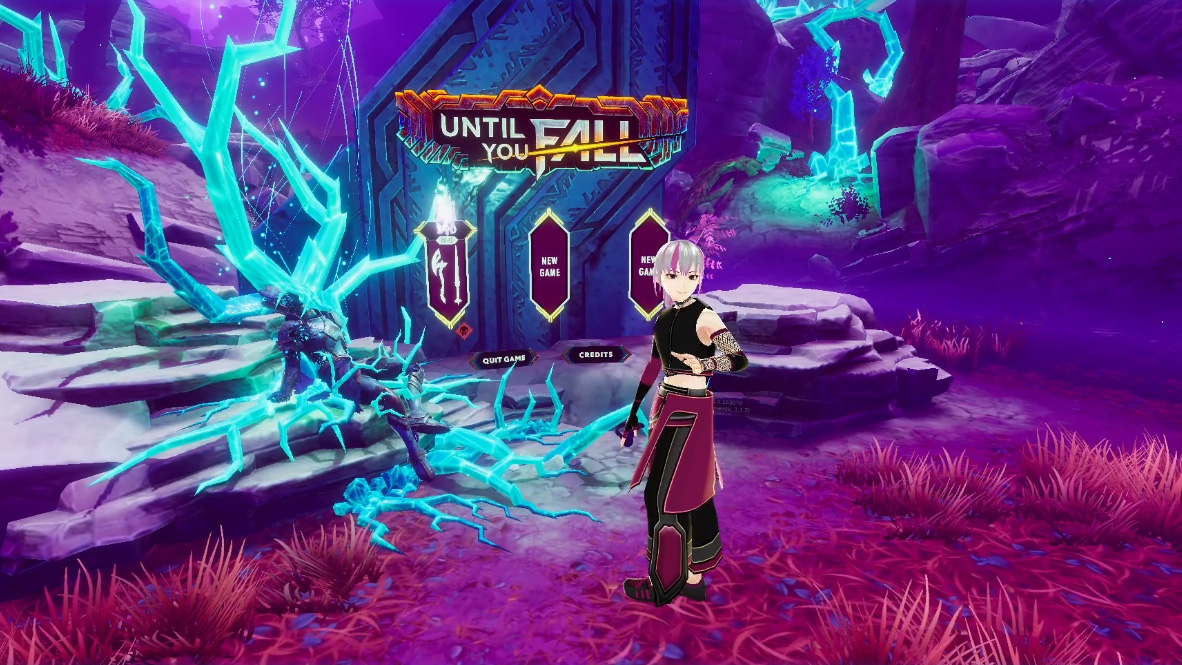
Until You Fall

When I heard the name of a game named Until You Fall I had no idea what kind of a game to envision. If it weren't a VR title I might have actually figured it out. The thing is, Until You Fall is a rogue-like game. Now the name makes sense! After you put on your headset and start the game you will become an unnamed last remaining rune knight who is the only one who can fight the horrors that ran over Rokar, once a magically advanced civilization. Equipped with one or two melee weapons, you can cast spells, dodge attacks, and hack and slash through magic monsters until you fall or after you defeat all the enemies and successfully run through the available campaign. Since this is a rogue-like game you are more likely to die many, many times before you defeat the final boss. The run consists of enclosed relatively small areas that are connected to each other. After you defeat a batch of randomly generated number of enemies in each area you will be allowed to pick a reward that will last for the remainder of the run. You can upgrade your weapons with abilities or you can upgrade your own abilities, or you can recover health or gain additional health. The last possible reward is Aether, a magical substance that works as a currency in the game. After you die, you appear in a hub where you can spend the Aether and let a runesmith forge you new weapons or spells or you can also let her upgrade them. The upgrades done by the runesmith are permanent. The weapons gain levels, their stats increase, their abilities get better. They also have a special ability that needs to be charged and then it can be used.

The actual combat is more of an arcade experience rather than mindlessly hacking and slashing at virtual enemies. There are two ways how to damage your foes. You can either hit them when they do not block which will slowly chip away some of their shield 'life' or you can block their attacks to destroy their shields for a while and then unleash a deadly combo that will deal huge amounts of health damage, the wider the attack the more damage. In order to combo off you need to align the attack with a line that will show up. After your maximum combo attacks end the enemy will become invulnerable for a while and will start attacking again. Before a foe attacks a blue bar will show up where the attack will land and it will start filling up with color. When it fills up the attack will land and will hit you unless you put one of your weapons there to block. Some attacks are slow but some are fast and can also come at you in quick succession. There are other attacks that will require you to dodge in a given direction, so you will need to be prepared to dive or tilt (or step out of range). You also have the ability to dash in any direction. You can either use this to avoid AoE, attacks with bigger reach or ranged attacks. You can also use this as an attack because it deals guard damage and can help you break the shield faster. There is a limit to how many times you can use it, but it replenishes quite fast. You can decide how to use this kind of an ability and upgrade it in a way that suits you. Similarly you can choose and upgrade the weapons you'll use in combat. The lighter the weapon the faster it moves. A dagger or rapier will simply follow the movement of your controller or tracker and thus are great for blocking but heavier weapons like a mace or axe will lag behind but can deal huge amounts of damage. Pretty cool feature for a VR game.

First few runs you might be a bit lost about how the game works. You will have to figure out the pace of the combat, when you can and can't attack (at some point enemies are invulnerable), and what weapon combination you want to use and which temporary upgrades will be the best for that combination. At first you might just want to go as far as possible just grabbing aether, buying all the weapons and testing them out (and upgrading those you want to use).

The key of survival is fighting enemies one by one or in smaller groups. When you fight one foe another might come and start attacking. You might see a exclamation mark show up and then hear the attack so you can turn after that sound, block the attack, and continue fighting either of the enemies you battle.

The world of Rokar is a very colorful place with neon glowing flora, magic and crystals. While it gets darker and darker the further you get it still has a great contrast. The particles, special effects and atmospheric effects make it feel even vibrant. The soundtrack suits the pace of the game and makes you want to stay active hacking and slashing at enemies to the rhythm of the songs. Sound effects are great and the spatial sound will help you orient in battle without the need to constantly look around, being afraid of an incoming attack.

The game can be played seated even though I wouldn't recommend it if you can stand on your feet. While you don't need to move around physically (you can use thumbsticks for that) it is often better to move in real life than to fiddle with the game's locomotion following your headset in the middle of a battle.

The locomotion and turning is the only downside of the game even though you may not need this that much while you play the game.

Verdict:
Until You Fall is very polished VR game that allows you to choose the way you will fight and offers you an environment in which you can become better and explore everything the game offers. It shows that there is a fun and efficient way how to approach melee combat in VR games. There is depth, complexity and freedom - you can just simply mindlessly run into the fray or carefuly study the game mechanics and enemy attacks first. The game has great visuals, effects, sound and music, quality of life features and great menu. It is a great game and experience.

Thank you for reading,
Ren

Monday, November 22, 2021

The Talos Principle

The Talos Principle is a puzzle game with a story that asks philosophical questions about being human, life, death and eternal life.

You will wake up in a garden and hear the words of Elohim, god-like creature claiming to have created you, guiding you one of his children to a temple and telling you to pass different kind of tests.

You will learn that you should be collecting Sigils to progress. Each of these is at the end of a spatial puzzle. Each of the puzzles is taking place in a closed area that can often feel like a labyrinth. You will have to deal with forcefields, sentinels (some explode when you walk closer to them), laser guns, closed door etc. For that you can use one or more tools you will get on your journey. For example, one tool will allow you to redirect laser beams, other will disable a forcefield or stop a sentinel in its track. There is also a cube that you can use in various ways (climb, or use to put pressure on something) and a fan that allows you to get to difficult to access places for example. One of the weirdest tools is a recording device (when you need two people to solve the puzzle).

The Sigils you will be collecting have a form of a tetrimino and are used to unlock doors. You will unlock a way to other very distinct worlds. In each world there is a hub from which there are doors leading to other parts of that one world. There you have the individual puzzles rewarding you with the Sigils. The Sigils have different colors and the difficulty of the puzzles is also reflected in that. You will start with collecting Green and Yellow Sigils mostly and these puzzles are quite easy. The green ones are good introductory puzzles, yellow ones are about testing what you learned from the green ones. In the later stages of the game all you will be collecting are red tetriminos and it is where it starts to get complicated. While exploring the worlds and solving puzzles you might come across golden stars. Those you can also collect and will take you through a hidden door to other puzzles. In order to get a golden star you will have to think outside of the individual puzzles, you will often need tools from different puzzles. There are different ways how to solve these and are very fun. Actually sometimes you won't even see the star itself, you will just encounter something that's not supposed to be there and after you get there you will discover a star. All the puzzles are very satisfying to solve and the star challenges were really brilliant and often breathtaking. The names of the puzzles are something to pay attention to, especially if you get stuck because they will give you a hint.

One of the great things is also the fact that you don't need to do any of the puzzles in a certain order but you do need to collect specific tetriminos and certain amount of stars in order to open doors. It gives you freedom and also won't frustrate you if you get stuck. You can just go do different puzzles and come back (to realize how simple the solution was). All the puzzles are very well designed and while some need you to stack objects in a certain way you will mostly be thinking about how to effectively use the tools at your disposal since you've got a limited amount which is lower than the number of obstacles.

While exploring you will encounter QR messages from other children, audio logs, and (beeping) terminals. This is where the story part of the game takes places. When you hear a beeping sound and go closer you will discover a terminal on which you can read messages and articles from a corrupted archive and this way you will learn that something went terribly wrong. You will start asking yourself questions and later you will start a conversation with conscious artificial intelligence. It is here where most of the philosophical questions will be asked. This being will start questioning you and you will have to think hard how to answer. Your point of view will then be questioned and it is up to you whether you change your mind or not. The thing is, you are a robot while you think you are a human being, but are you?

You will start to think about mythology, eternal life, God, technology and (trans)humanity. Maybe you'll start pondering about your own future and the future of today's society. You will always be given a lot of time to ponder about all these questions and doing puzzles in the meantime. When you hear the next beep, you will most probably be ready for next encounter.

The conscious in the computer system will start making you doubt your creator - Elohim. You will most probably start questioning Elohim (hopefully because than the game will end prematurely) and start wondering what's at the top of the Tower which he forbid you to visit and will remind you of it whenever you start climbing up. If you decide to climb the tower you will learn even more and will still be able to decide what the outcome of the game will be.

I'm not entirely sure how to write about all that is going on in the game, I'm not that good of a writer. The experience is very unique and personal. The story is very deep, poses very important questions and everything is very well written. In all that there is even room for humor.

Even though I wanted to end the review here, I should also comment on graphics and sound. The game is very beautiful. The environments are large and I spent hours just walking around enjoying the view, the atmosferical effects and even tried to reach different places to see the environment from different point of views. This sometimes resulted in me stumbling upon a golden star. I had no problems with performance in VR and enjoyed a crystal clear and sharp textures all the time no matter how fast I moved or how close I was a wall. I was actually surprised how well the game looks on Rift because many games don't that great compared to Index. I would have never guessed this game is from 2014. Music and sound is excellent. Music is a delight and I'd just stand on the beach, watch the setting sun and listen to the music. The little voice acting there is, is impeccable - in terms of it makes you feel emotions and not many games I played achieved that.

Verdict:
I bought this game for the puzzles but very soon realized that it is not about the puzzles. While the game can be played just as a puzzle game, and very good one, you will miss a lot if you ignore the story. The story is philosophical, thought-provoking, well written. The game has a very good learning curve, is also well structured and offers even more challenging puzzles to hardcore players. The game environments are distinct, beautiful, breathtaking and simply serene. The music is soothing for the soul. In overall it is a perfect game.

Thanks for reading
Ren